AI coding environments for the other 80% of your enterprise.
Your company already pays for AI coding tools like Claude Code, Cursor, and Copilot. 80% of your workforce can't use them because the environment setup requires a developer. Vibebox packages the entire environment into a managed app — IT deploys once, the user signs in and builds. No terminal. No tickets.
Not a new AI tool. The deployment layer for the ones you already pay for.
This is what one of your non-technical experts sees the first time they try to set up an AI coding assistant — Claude Code, Cursor, GitHub Copilot, take your pick — on a corporate laptop.
Vibebox eliminates everything above. Your AI coding tools, pre-configured and ready.
One product. Every seat at the table.
For leadership
AI-assisted development is already happening inside your company — governed or not. Vibebox lets you turn it on across every business unit with full spend visibility, per-user budget caps, and an audit trail your compliance team can actually work with. The ROI shows up in weeks, not quarters.
For the non-technical builder
You don't need to learn what Node.js is. You don't need to know what a terminal is. Sign in with your work credentials and the AI coding tools your company already pays for are ready to go. Describe what you want to build and Claude Code, Cursor, or Copilot handles the rest. No setup. No tickets. No waiting.
For IT and security
Vibebox doesn't ask you to lower the bar. It gives you the controls you've been missing: SSO enforcement, proxy and TLS cert injection, network policy, per-user spend caps, a tool catalog with approval workflows, and an append-only audit log. Configure the base image once. Every user gets the same governed environment. Your helpdesk never fields another npm cert ticket.
For the engineer who became tech support
You were hired to build infrastructure. Instead you're spending your weeks explaining what localhost means. Every setup is the same 45-minute walkthrough — and there are more waiting than you'll ever get to. Vibebox does what you do, automatically, every time. You get your calendar back.
For the IT skim. The product without the marketing.
Local VM, hardware-isolated
Runs in WSL2 on Windows and Apple Virtualization.framework on Mac. The sandbox sits behind a hardware boundary from the host machine.
One IT-controlled enrollment config
A single config file your IT team owns drives SSO, proxy, CA certs, API key delivery, the tool catalog, and network policy.
Podman, rootless
Containers without a Docker Desktop license. Rootless by default. No daemon running with elevated privileges.
iptables egress policy
Outbound traffic is filtered against an IT-defined allowlist. Traffic is logged so your security team can review what the sandbox actually called.
API keys never touch disk
Keys are delivered into the sandbox via memory-only tmpfs or injected at the network layer. Designed so a workspace teardown wipes them with the VM.
Vibebox. Your AI coding tools, deployed to everyone.
Your company bought Claude Code, Cursor, or Copilot. Vibebox gets them running on every employee's machine with zero setup. IT configures the environment once — runtimes, proxy, certs, API keys, spend caps — and deploys it like managed software. One installer. One SSO sign-in. The user is at a working prompt.
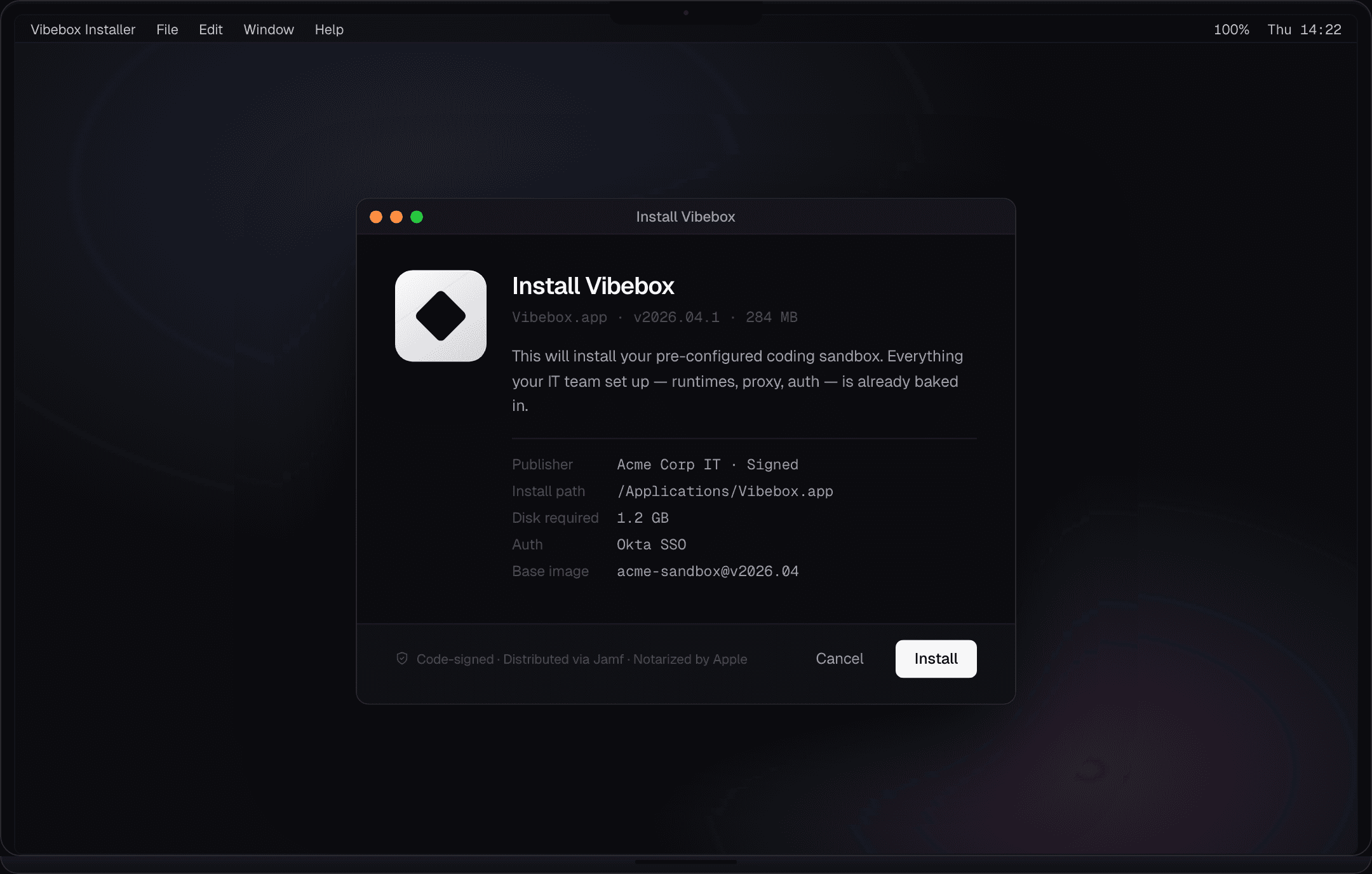
Install
IT deploys the installer through SCCM, Intune, or Jamf. The user double-clicks the icon. No admin rights, no terminal, 284 MB on disk.
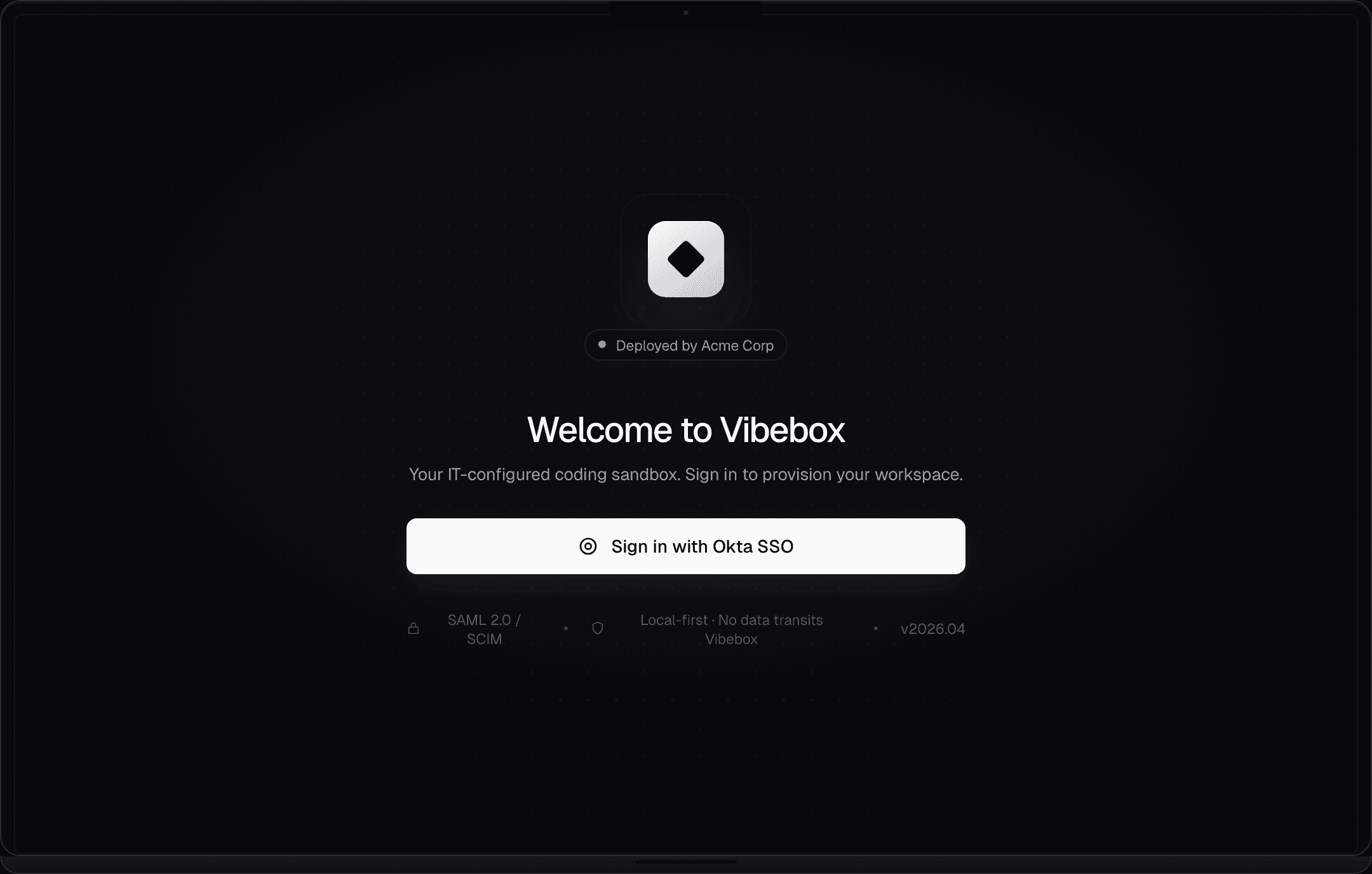
Authenticate
One-click SSO against Okta, Azure AD, or Ping. SAML 2.0 with SCIM provisioning. The user signs in with the same credentials they use for everything else.
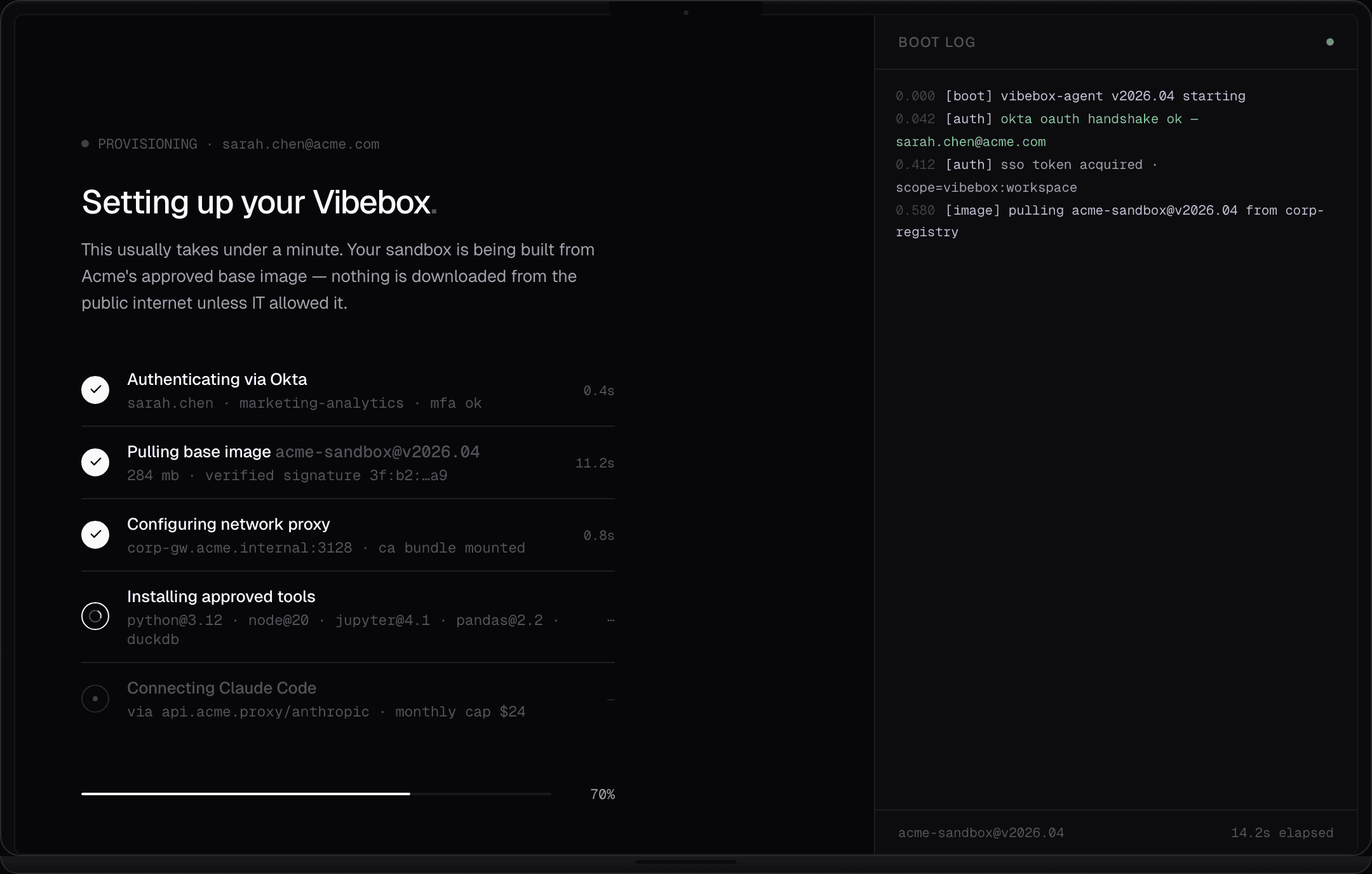
Provision
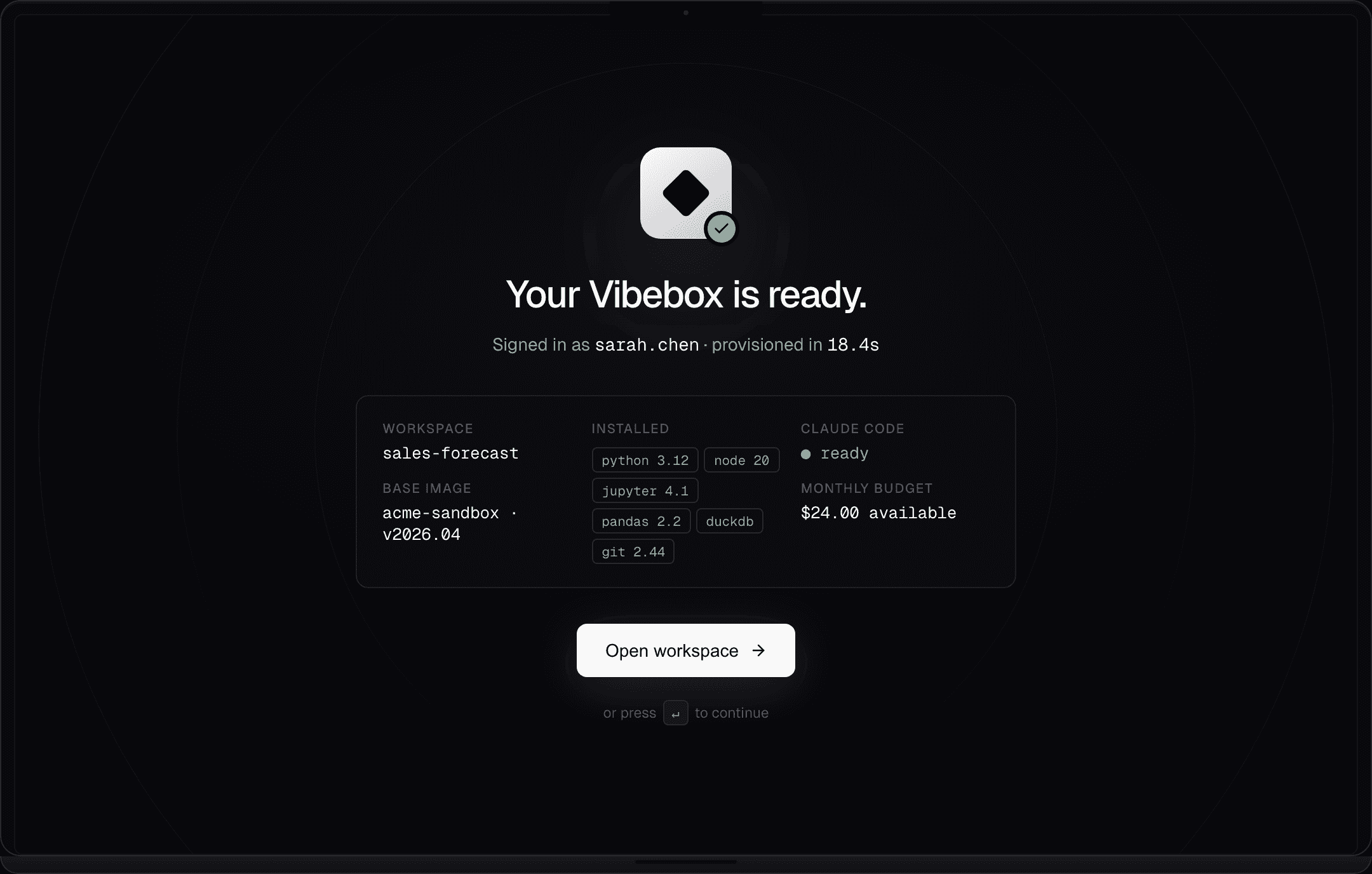
The sandbox builds itself typically in under a minute. Base image, proxy, CA certificates, approved tools, and AI coding assistants — Claude Code, Cursor, GitHub Copilot, or whatever IT has cleared — connect automatically. A live progress log shows exactly what is happening.
Ready
Workspace provisioned, tools installed, the approved AI coding assistant connected, monthly AI budget visible. The user sees everything they have, and nothing they do not need.
Build
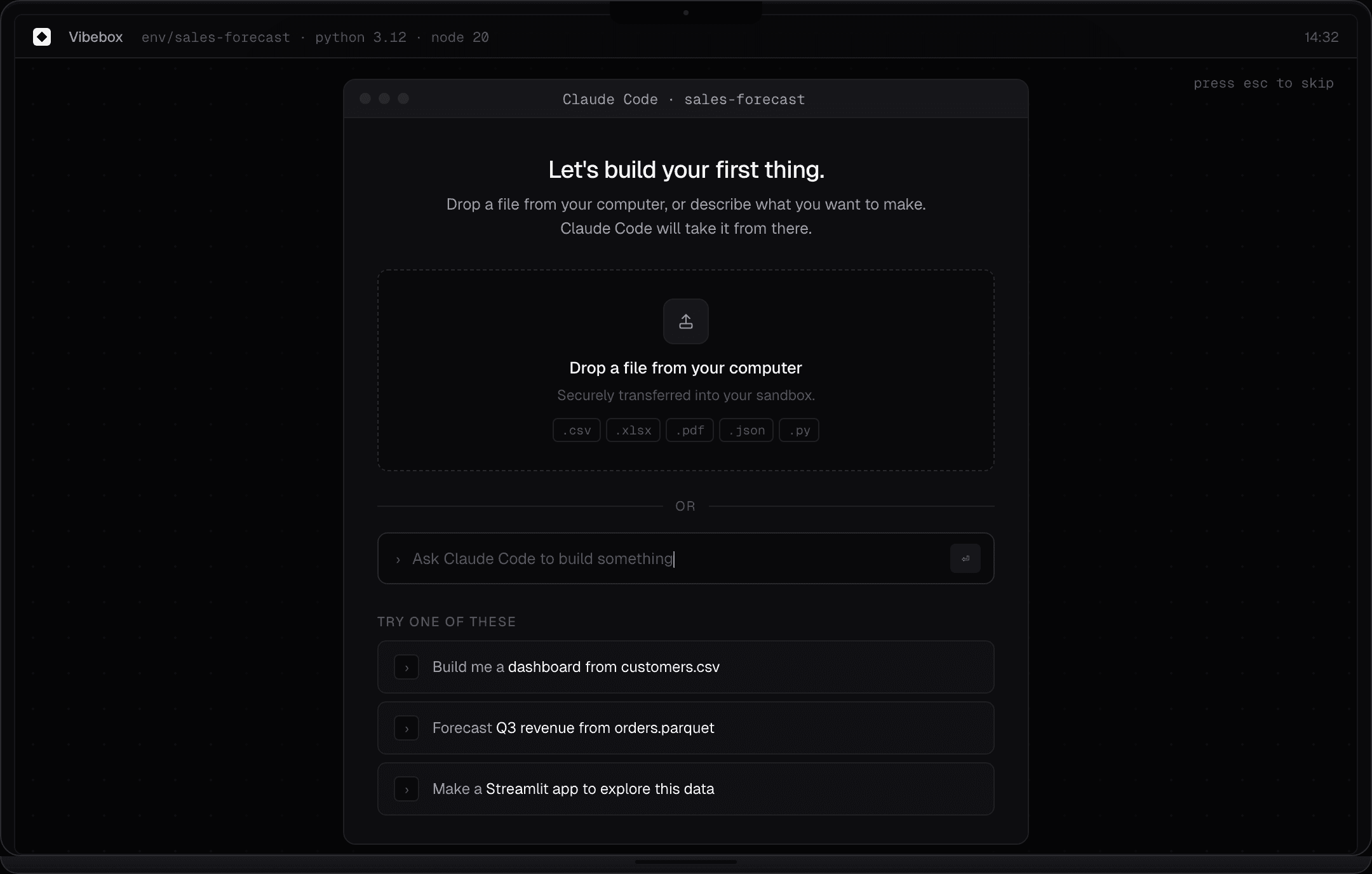
Drop a CSV. Ask the AI coding tool of choice — Claude Code, Cursor, Copilot — to build a dashboard. That is the first experience. No Git, no terminal, no configuration. Just: “Build me a dashboard from customers.csv.”
What your team can build. Working software, not requirements docs.
- Operations director
A Jira automation that saves 6 hours a week.
- Insurance underwriter
A risk-scoring model from claims history.
- Finance analyst
A competitive intelligence dashboard from public filings.
- Marketing manager
A campaign attribution dashboard from CRM exports.
- Clinical research lead
An enrollment forecaster from study CSV exports.
- Product manager
A Streamlit app that replaces a $40K/year SaaS tool.
These are the kinds of internal tools a competent AI coding assistant can produce in a few hours, when the environment around it is set up right. Vibebox is what gets a non-engineer from zero to that environment.
Everyone owns a piece of this. Nobody owns the whole thing.
Cloud dev environments
Codespaces · Replit · Bolt.newCan’t run locally. Regulated buyers across finance, insurance, healthcare, life sciences, and legal generally won’t send source data or prompts to multitenant cloud infrastructure their compliance teams haven’t cleared.
Self-hosted dev platforms
Coder · Gitpod / OnaTarget platform engineering teams, not non-technical users. They assume the user knows what a workspace template is.
Low-code platforms
Power Platform · OutSystems · MendixLock you into their ecosystem. You can't edit arbitrary Python or use your company's custom React component library.
MicroVM tools
smol machines · MicrosandboxDeveloper primitives, not packaged products. They’re the substrate Vibebox is built on top of, not the thing an analyst can install on their own laptop.
Vibebox sits above all of them. A local-first sandbox, a turnkey installer, enterprise identity and proxy and cert injection, an IT-controlled tool catalog, AI spend visibility, and a UX a non-engineer can actually use without reading any of the documentation we just listed.
How does Vibebox work with your existing toolset?
AI coding tools
Claude Code · Cursor · GitHub CopilotVibebox runs whichever AI coding assistant your company already licenses, inside the sandbox. Bring your existing seats — the user signs in and they're at a working prompt. Swap tools later? IT replaces the binary in the catalog and the user doesn't notice.
Identity & SSO
Okta · Azure AD · PingSAML 2.0 plus SCIM provisioning against your existing IdP. Users log in with the same credentials they use for everything else — no separate Vibebox account. Deprovision upstream and the sandbox locks on the next sync.
Network & security
Zscaler · Netskope · Palo AltoVibebox honors your enterprise proxy and CA bundle automatically. TLS inspection works out of the box. AI traffic flows through the gateway your security team already audits — same DLP, same egress logs, same firewall rules.
Endpoint management
Intune · Jamf · SCCMDeploy Vibebox like any other managed app. Signed MSI for Windows, signed PKG for macOS. No new agent, no new console, no separate approval cycle. Push the install on Monday, every employee is provisioned by Tuesday.
“I spend my weeks installing Node.js for non-engineers. I’m building the thing that makes me obsolete.”
I’m an AI software engineer, a builder, and these days, vibe-code tech support. I shouldn’t be.
What it actually looks like most weeks: Teams calls helping non-technical colleagues get their machines into a state where they can vibe code. Installing Node.js, configuring proxy certs, explaining what VS Code is, debugging nvm installs that IT can’t approve. There are hundreds of people in line behind every one of those calls.
I started building Vibebox because I’m tired of being the bottleneck. These people don’t need me. They need a box that does what I do, every time, with IT’s blessing.
Before this I ran Shadow Solutions, a five-person software agency, and shipped four SaaS products in parallel. BS in Chemistry and CS from UIUC. Four rotations across R&D IT, commercial, business strategy, and cybersecurity at a Fortune 100 pharma, including a stint in Ludwigshafen, Germany.
I’m not reading market reports about this problem. I’m living it. Every week.
- Fortune 100 pharma
- UIUC
- Shadow Solutions
Your best builders don’t know what a terminal is. They shouldn’t have to.
The next wave of enterprise software isn’t getting written by engineering teams working off requirements docs. It’s getting described, in plain English, by the people who actually understand the problems. The operations director who has run Jira workflows for a decade and knows where the bottleneck is. The finance analyst who’s modeled risk for fifteen years. The supply-chain planner who could spot an inventory anomaly in an afternoon if she could just get her ERP export into a working dashboard.
These are not people who need to “learn to code.” They have something more valuable: twenty years of domain expertise, an intimate understanding of the business process, and access to AI tools that can turn plain English into working software.
Then they hit the wall.
They don’t know what Python is, let alone how to install it. They’ve never used a terminal or touched cd. They’ve never heard of Node.js, npm, or Git. As far as they know, VS Code is just another app icon, not an elaborate text editor that needs extensions, settings, and a runtime underneath it.
The real problem is that they don’t know what they don’t know. They can’t even articulate the right question to ask. IT can’t help either; they don’t know the vibe-coding stack.
So your best engineers, the ones who should be architecting AI systems and shipping agent infrastructure, become $200/hour tech support. They spend their weeks on Teams calls explaining what localhost means while their actual projects stall. Hundreds of people are in line behind each one.
The toolchain is depreciating.
Most of the knowledge that used to matter (Git commands, package managers, terminal navigation, environment variables) is depreciating fast. Nobody needs to learn git rebase when an AI agent handles version control. Nobody needs to understand pip install when the environment is already configured. That knowledge is about to be irrelevant, and we’re still asking people to learn it before they’re allowed to build anything.
The new literacy is plain language. Describe what you want, the AI builds it, and the people who are best at describing domain problems in plain language are the subject-matter experts already on payroll.
They don’t need to learn the toolchain. They need it out of the way. Once it is, they stop being the stakeholder who files a Jira ticket and start being the builder who delivers a working prototype to engineering.